Of all the environmental aspects shaping your health, whether at home, in the office, or any other indoor space, light may be the most powerful and the most misunderstood. It sets your body clock, and with it your sleep, your mood, and how well you think. Here is how it works, and how a home can be built around it.
We evolved under one lighting scheme: bright, blue-rich sunlight all day, and near-darkness at night, broken only by fire. Every system in the body learned to read that rhythm. Then, during the last century, we inverted it. We now spend our days indoors under light far dimmer than the sky, and our evenings under light bright enough to once have meant midday. Our biology has not caught up.
How light runs your clock
Deep in the brain sits a master clock that keeps the whole body on a roughly 24-hour schedule. Its main way of knowing the time comes through your eyes, from a set of cells in the retina that respond to light, and to blue wavelengths most of all. This has been well established since the early 2000s. These cells contribute little to vision; their main job is to tell your brain whether it is day or night. Get that signal right and the things downstream – sleep, alertness, hormones – tend to fall into place. Get it wrong and they drift.
Sleep
This is the best-understood part. In the evening, bright and especially blue-rich light suppresses melatonin, the hormone that prepares you for sleep, and pushes your clock later. In the morning, bright light does the opposite: it anchors the clock and, hours later, helps you fall asleep on time. So a good night often begins with a bright morning. Most homes get both halves wrong, too dim by day and too bright by night.
Mood
Light and mood are tied together more tightly than we tend to assume. The clearest evidence is bright-light therapy for seasonal depression, a well-established treatment. Beyond that specific case, low daytime light exposure is associated with lower mood, and while the broader claims are still being refined, the direction is consistent: more bright light during the day tends to lift how people feel. A dim, sunless home is not only harder to see in; over months, it can weigh on you.
Focus and the mind
Daytime light also affects how sharply you think. Brighter light during working hours is linked to better alertness and some aspects of cognitive performance, which is why a well-lit morning space does more for the day than another coffee. The evidence here is supported rather than fully settled, so I hold it a little more lightly than the sleep science, but the practical advice points the same way: get real light on your eyes early.
Why "how bright" misses the point
Here's where most advice goes wrong. We measure light in lux, a number built around how bright things look to the eye. But the cells that run your clock do not care about that number. They respond to only one slice of the spectrum, the blue-green part, so two lamps can read the same in lux and send completely different messages to your body clock. Researchers use another measure for this, melanopic EDI (m-EDI), which weights light by how much it actually stimulates those cells. That is the number that matters, and it is almost never the one printed on the box.
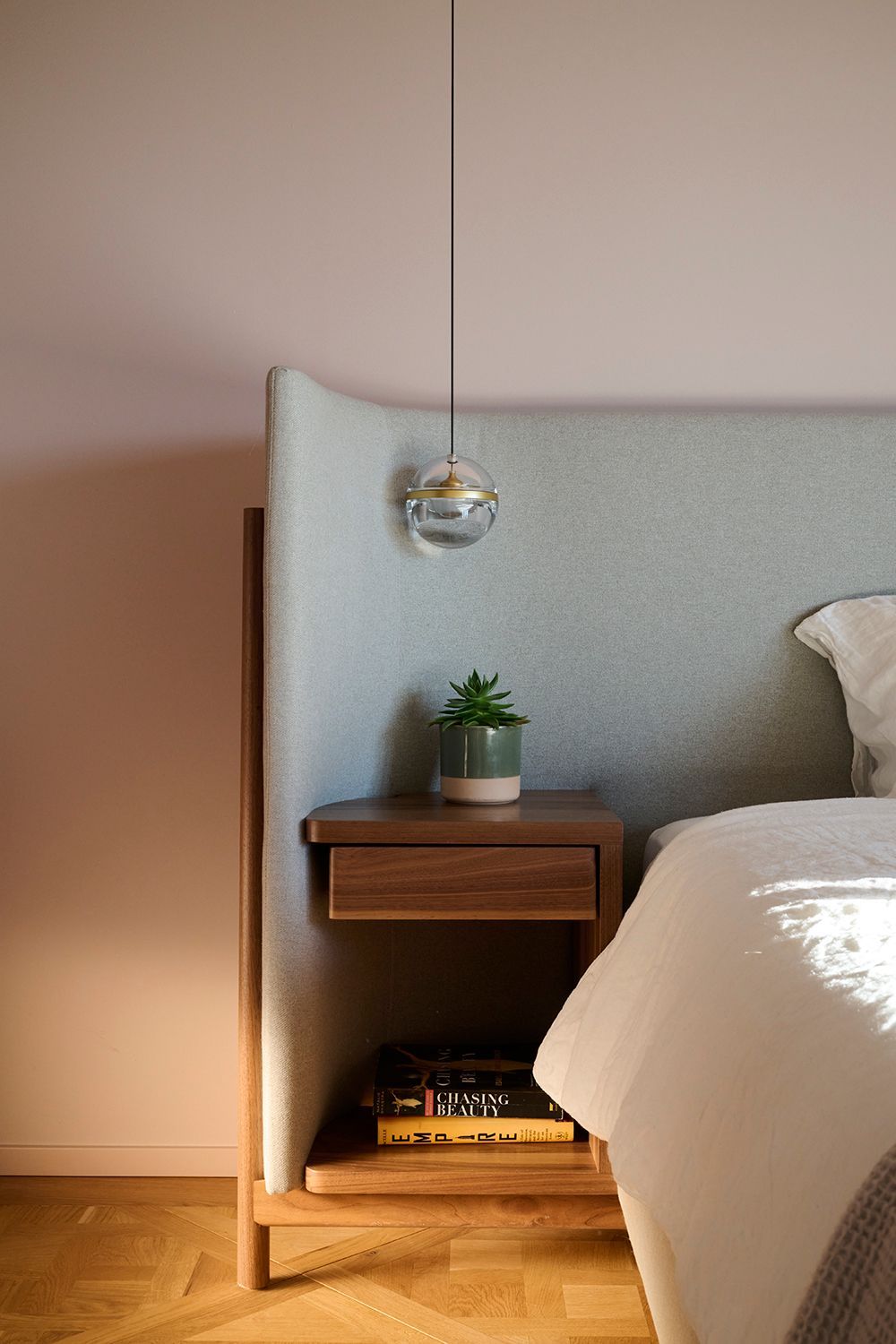
And it’s not only about the bulb. What counts is the light that reaches your eyes, not the light in the room. A bright fixture overhead, straight in your line of sight, sends a far stronger signal than the same light from a low lamp beside you, angled away. This is why placement matters as much as the bulb itself: in the evening, light should sit low and out of your direct view; in the morning, daylight should reach your eyes easily. Where a light sits can count as much as its color or intensity.
A problem of design, not willpower
You cannot behave your way out of a badly lit home, but it’s possible to design one better aligned with our circadian clocks. The orientation of the rooms, the amount of light they receive, morning routines aligned with where the sun hits, and of course the position, spectrum, intensity, and variation of every source of artificial light. Outdoors on a clear day your eyes receive tens of thousands of lux, and, because daylight is the reference for m-EDI, a melanopic dose of the same order. Researchers recommend a daytime minimum of about 250 m-EDI at the eye, and a typical room, away from the window, often falls short of it. At night the gap flips: outdoors you'd have almost none, while a normally lit room still exceeds the evening target of under 10, sometimes several times over. Good design can help shrink the gaps without any additional effort on your part.
How I design with light
Designing with light means both making the most of the available natural light and selecting artificial light sources that are most closely aligned with circadian rhythms.
Concretely, that means whenever possible I orient bedrooms towards the east, to maximize the morning sun, and when windows are replaced I choose models with more glass surface than standard renovation options. For artificial lighting, I source the best options available in terms of color and intensity, ensuring they are flicker-free and dimmable via a centralized automation system. When they are available, I propose table lamps and other evening lighting with low levels of blue-spectrum light. The Longevity Audit is when I check whether your lighting is currently working for or against you. From there comes the design and optimizations. And none of this is at war with beauty. Light is also the most powerful tool a designer has for atmosphere, so the light that serves your clock and the light that makes a room feel wonderful are, more often than not, the same light.
Where you can start right now
You don't need a renovation to begin. Get outside, or beside an open window, within an hour of waking. Work near daylight. Take frequent short breaks outdoors. In the evening, drop the overhead lights in favor of low, warm lamps, and dim what you can. Invest in blackout curtains for your bedroom. Tonight, notice how bright your rooms are after dark, and how dim they are at noon. You will see the problem for yourself.
A reminder
Light is more than decoration. It is one of the oldest signals your body knows how to read, and it is reading it right now. Designed well, a home speaks to that signal all day: bright when you need to be awake, soft when you need to rest, and beautiful throughout.
So here is the question worth sitting with. Across a whole day, is the light in your home telling your body the truth about what time it is?